

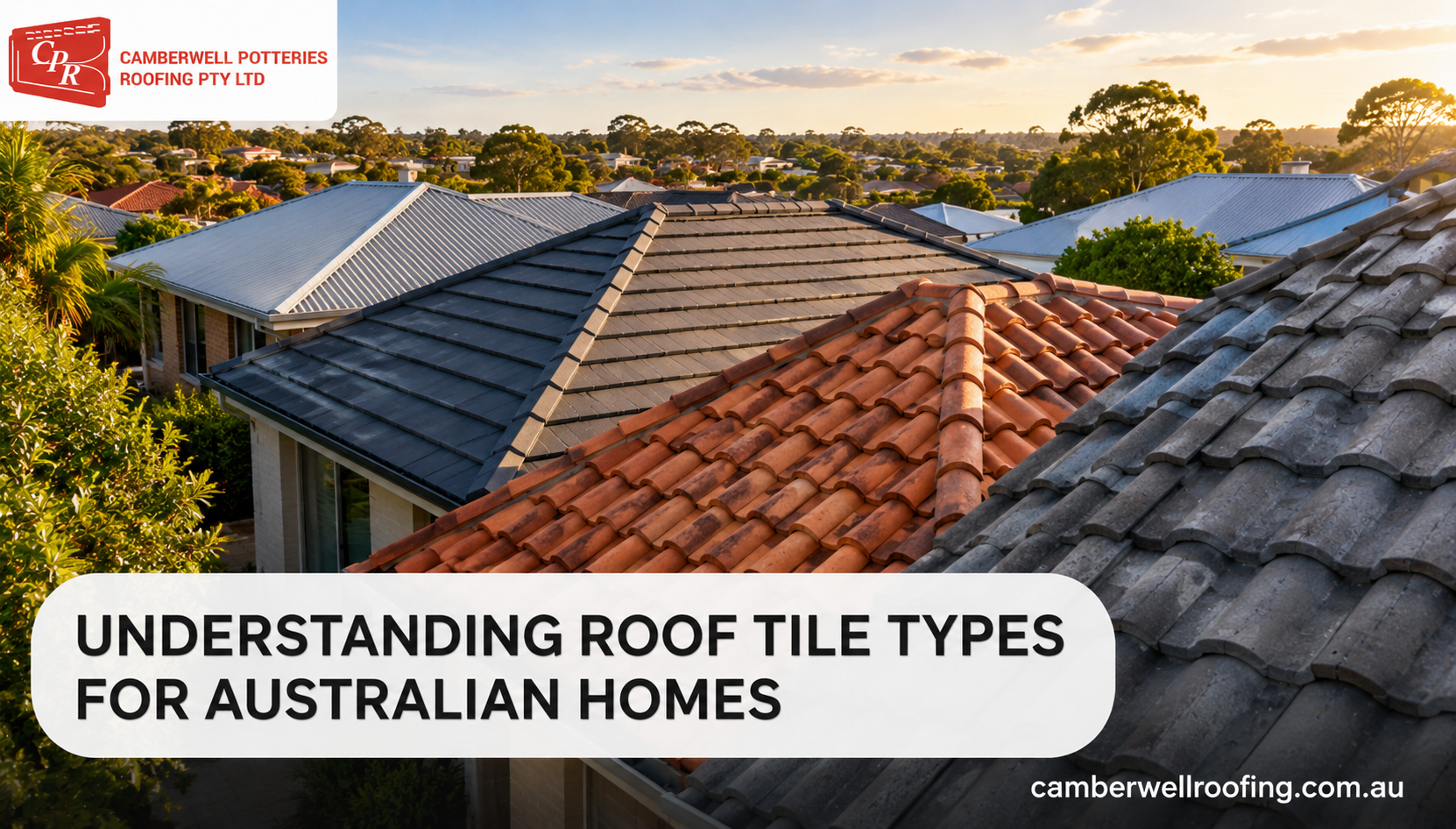
Understanding Roof Tile Types for Australian Homes
Most homeowners have never had to think seriously about roof tiles before. Then the roof needs replacing, and suddenly there are three material options, different lifespans, and a contractor asking which one you want. Making that call without any background knowledge is genuinely difficult.
The choice matters more than most people realise. The right material, matched properly to the home, lasts decades longer than a mismatched one. This guide covers the main roof tile materials Australia-wide, so you walk into that conversation already knowing what to ask.
How the Main Tile Types Compare
| Material | Lifespan | Insulation | Maintenance Level | Best For |
| Terracotta | 50 to 100+ years | Excellent | Low | Heritage and premium homes |
| Concrete | 30 to 50 years | Good | Moderate | Standard residential builds |
| Colorbond steel | 30 to 50 years | Moderate | Low | Modern and lightweight builds |
| Slate | 75 to 150 years | Good | Very low | Premium heritage properties |
1. Terracotta Roof Tiles
Terracotta is the oldest roofing material still widely used across Australia. It is made from natural clay fired at high temperatures. That process gives it a density and hardness that most other materials simply cannot match.
Why Melbourne homeowners choose terracotta:
- Does not warp in summer heat or crack under frost
- Salt air from coastal environments does not affect it
- Naturally regulates interior temperature through thermal mass
- Colours do not fade over the life of the tile
- CSR Monier terracotta tiles carry a 50-year warranty
Roof lifespan by material rarely gets better than terracotta. A properly maintained terracotta roof can last close to a century. Some heritage properties in Melbourne’s inner east still have original tiles performing well after 80 or 90 years.
Roofing insulation performance is one of terracotta’s genuine strengths. The material is a poor conductor of heat. External temperature extremes take longer to transfer through to the interior, which keeps heating and cooling costs lower over time.
Maintenance requirements:
- Annual gutter clearing to prevent debris from sitting against tiles
- Moss and lichen treatment every few years as needed
- Individual cracked tiles are replaced as they occur
- Professional inspection every two to three years
2. Concrete Roof Tiles
The concrete roof tiles Melbourne homeowners choose are the most common tile type in standard residential builds across the city. They are made from sand, cement, and water pressed under high pressure. The result is a dense, durable tile that performs well across most Melbourne conditions.
Concrete tiles have a lower profile than terracotta. That gives roofs a cleaner, more contemporary look. The colour range available through CSR Monier includes a wide variety of sands, pigments, and finishes that suit both traditional and modern architecture.
Where concrete tiles perform well:
- Impervious to frost and ice in cooler outer suburbs
- Dense enough to suppress rain and hail noise effectively
- Resistant to corrosion and salt air in coastal suburbs
- Available in a wide range of colours and profiles
The honest limitation:
Concrete absorbs moisture more than terracotta over time. This affects the surface coating gradually, which is why periodic resealing is part of proper maintenance. Concrete tiles also weigh significantly more than Colorbond, so older homes may need a structural assessment first.
Roofing maintenance requirements for concrete tiles:
- Resealing every ten to fifteen years
- Gutter cleaning twice a year minimum
- Moss treatment on south-facing slopes as needed
- Inspection after significant storm events
3. Colorbond Steel
Colorbond has grown more popular in Melbourne over the last two decades than any other roofing material. It is a steel sheeting product from BlueScope with a thermoset paint finish and a warranty of up to 36 years, depending on product grade.
The practical advantages:
- Lightweight — suits older homes where the timber frame has load limits
- No individual tiles to crack, break, or replace after hailstorms
- Faster installation than tiled roofing
- Low ongoing maintenance once installed
Where the roofing material comparison gets important:
Roofing insulation performance with Colorbond depends heavily on the sarking and insulation installed underneath the sheets. Steel transfers heat quickly in both directions. Without proper underlayment, a Colorbond roof makes a home hotter in summer and colder in winter than a tiled equivalent. Correctly installed with quality sarking, that gap closes significantly.
Colorbond suits modern architecture, flat or low-pitch roof designs, and homeowners who want minimal ongoing maintenance. It is less suited to heritage suburbs where council overlays may restrict its use.
4. Slate Tiles
Slate sits at the premium end of the roof tile durability comparison. It is a natural stone material with a proven track record across more than a century of Australian roofing. Melbourne’s inner heritage suburbs still have functioning slate roofs from the Victorian and Edwardian eras.
Why Slate performs so well over time:
- Does not absorb water the way concrete does
- Does not support moss growth to the same degree
- Does not fade or change colour over decades
- Fire-resistant and frost-proof
The honest constraint with slate is cost and availability. Matching slate for repairs on an existing heritage roof can be difficult and expensive. New installations carry a significant price premium over concrete or terracotta.
For heritage properties where council overlays require original materials, slate is sometimes not a choice but a requirement. For everyone else, it is a premium option suited to homeowners who want the longest possible lifespan.
How to Choose Between Them
The best roofing materials for homes in Melbourne always depend on four things: what the existing roof structure can support, what the local council overlay permits, what the architectural style of the home is, and what maintenance commitment the homeowner is willing to make.
| Your Situation | Material to Consider |
| Heritage home in inner Melbourne | Terracotta or slate |
| Standard suburban home any era | Concrete tiles |
| Modern home or lightweight structure | Colorbond steel |
| Heritage overlay requiring original materials | Slate |
| Coastal suburb with salt air exposure | Terracotta or concrete |
Roof lifespan by material should also factor into any budget conversation. A terracotta roof lasting 80 years costs less over time than three concrete tile replacements across the same period. That long-term calculation is something experienced contractors factor into their recommendations from the start.
Which Material Is Right for Your Home?
Roof tile materials Australia-wide are not all equivalent. The right choice for one Melbourne home can be wrong for a property two streets away. Heritage overlays, structural load limits, roof pitch, and orientation all affect which material performs best in any specific situation.
Camberwell Potteries Roofing works with both terracotta and concrete roof tiles Melbourne across new roofing, re-roofing, and restoration projects. As a trusted roofing contractor Melbourne homeowners have relied on for over 60 years, the team are accredited CSR Roofing Specialists carrying a 50-year performance guarantee.
The advice always starts with your specific home rather than a standard recommendation.
Call 03 9888 7088 or contact the team online to get started.


